In pumps used for power generation, water treatment, industrial processing, defense, and other demanding applications, the impeller is where engineering design meets fluid dynamics. And among the different impeller designs a foundry may encounter, the shrouded impeller can be one of the most challenging castings to produce successfully.
Its appearance can be deceiving. A finished shrouded impeller may look relatively straightforward from the outside, but internally it contains precisely shaped passages that must move fluid efficiently while maintaining the strength, balance, and dimensional accuracy required by the application.
For a foundry, getting all of those characteristics right in a single casting requires experience, process control, and an understanding of how molten metal behaves inside complicated geometry.
What Makes a Shrouded Impeller Different?
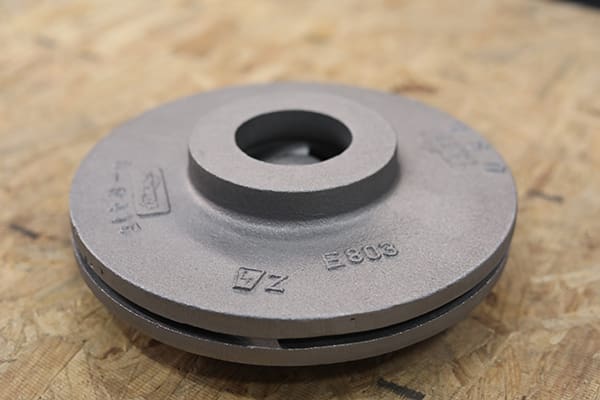
Unlike an open impeller, a shrouded—or closed—impeller incorporates vanes enclosed between front and rear shrouds. The resulting internal waterways are essential to the pump’s hydraulic performance.
Those same enclosed passages create a significant casting challenge.
The foundry must reproduce complex internal geometry that cannot simply be machined into the casting afterward. Cores and molding processes therefore become critical to establishing the shape and surface of the waterways.
This means decisions made before metal ever reaches the mold can ultimately influence the performance of the finished component.
Controlling Metal Flow
When molten metal enters a complex mold, it must reach every part of the casting while remaining sufficiently fluid and avoiding conditions that can create defects.
A shrouded impeller combines relatively thin vanes and internal passages with heavier sections such as the hub. Those differences in section thickness can cause different portions of the casting to cool and solidify at different rates.
Foundry engineers must therefore consider factors such as gating, risering, pouring temperature, solidification, shrinkage and feeding.
The goal isn’t merely to fill the mold. It is to produce a sound casting throughout the component.
The Waterways Matter
For pump manufacturers, internal geometry is especially important because the casting is part of a hydraulic system.
Variations in vane geometry or internal surfaces can affect fluid flow and potentially create additional finishing or machining requirements. The quality of the mold and cores used to establish those passages consequently matters well beyond appearance.
This is one reason experience with pump and valve castings is valuable. A foundry needs to understand not only how to pour the component, but also why particular features matter to the finished application.
Material Adds Another Layer of Complexity
Shrouded impellers may also be specified in materials selected for corrosion resistance, erosion resistance, strength, temperature, or the characteristics of the fluid being pumped.
Different alloys behave differently during melting, pouring, cooling, and heat treatment. A geometry that is challenging in one material may become considerably more demanding in another.
Successful production therefore requires the foundry to understand the relationship between alloy selection, casting geometry, process design and final specifications.
Inspection Is Part of the Process
Complex castings may also require dimensional verification, material testing, nondestructive examination, or other quality controls depending on the customer’s specifications and service environment.
The important question for a buyer isn’t simply, “Can this foundry pour an impeller?”
A better question is:
“Does this foundry have the experience, people, processes, pattern capabilities, metallurgy, and quality systems necessary to consistently produce my particular impeller?”
That distinction becomes especially important for low-volume, specialty, replacement, power-generation, military, and other demanding applications.
Bring Effort Your Difficult Casting
At Effort Foundry, difficult castings are familiar territory. Our experience with pump and valve components, shrouded impellers, complex internal geometries, specialized alloys, patternmaking, and extensive testing capabilities allows us to evaluate projects that require more than simply pouring metal into a mold.
Sometimes the best place to start is with a drawing.
If you’re developing a new impeller, replacing an existing casting, experiencing problems with your current source, or have a difficult casting other foundries are hesitant to tackle, send it to the Effort Foundry team for review.
Our sales and technical teams can discuss the geometry, material, quantities, pattern requirements, testing specifications, and other factors that determine the best path forward.
Have a difficult casting? Challenge Effort.