Testing & Quality: Why Confidence in Every Casting Begins Long Before the Pour
From chemical analysis and nondestructive inspection to mechanical testing and material verification, discover why quality assurance is essential for demanding industrial castings.
In industries such as power generation, military, nuclear, and industrial pump and valve manufacturing, a casting is much more than a piece of shaped metal. It is a critical component that may need to withstand extreme temperatures, high pressures, corrosive environments, and years of demanding service.
For engineers and purchasing professionals, selecting a foundry involves more than evaluating price and delivery. It requires confidence that the finished casting will meet the specified material, dimensional, mechanical, and quality requirements.
At Effort Foundry, quality is built into the manufacturing process through experienced personnel, established procedures, specialized inspection equipment, and extensive laboratory testing.
ISO certified since 2006, Effort Foundry combines decades of casting experience with the testing capabilities needed for demanding applications. Its quality management system is certified to ISO 9001:2015, with the current published certificate valid through March 2027, subject to surveillance audits.
Foundry Quality Begins Before Molten Metal Enters the Mold
A common misconception is that quality assurance happens primarily after a casting has been poured. In reality, some of the most important quality decisions occur before manufacturing begins.
Engineers must evaluate alloy specifications, casting geometry, molding processes, solidification characteristics, heat treatment requirements, and inspection criteria.
For example, a complex shrouded impeller may require precise internal waterways, while a high-pressure valve body may have strict requirements for material integrity and dimensional accuracy.
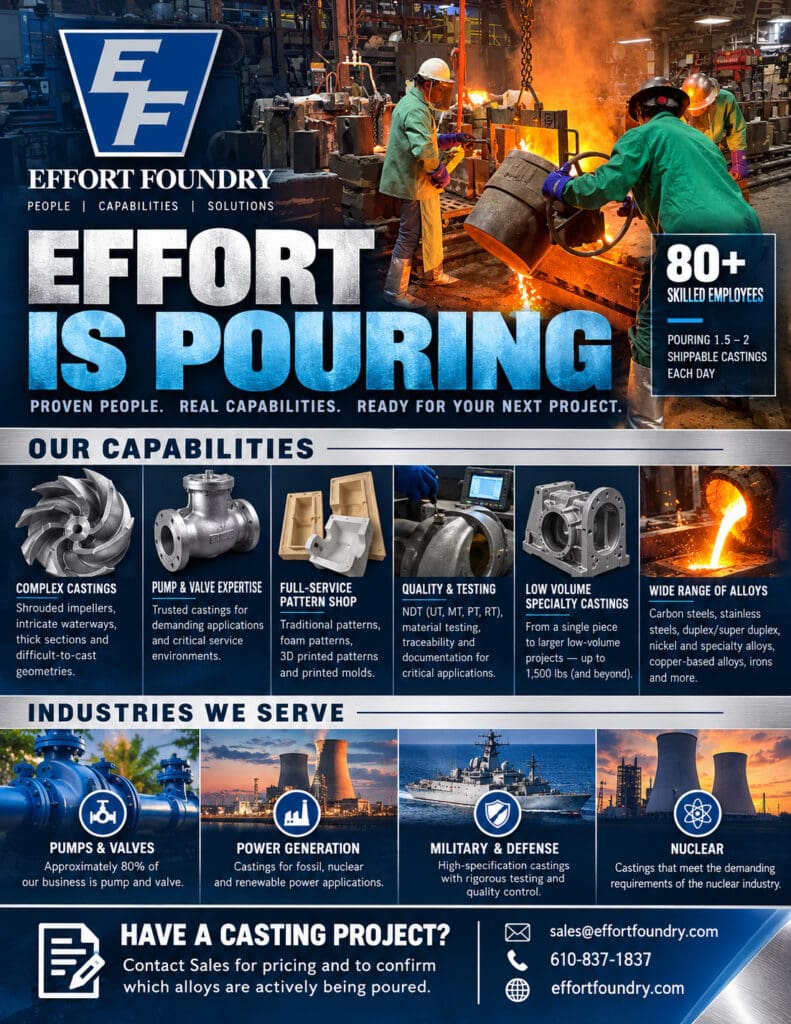
Effort Foundry’s casting capabilities include specialty alloys, complex geometries, low-volume production, heat treatment, and machining. Integrating these capabilities with quality planning helps address potential manufacturing challenges early.
Nondestructive Testing: Looking Beyond the Surface
A casting may appear flawless externally while containing discontinuities that require further evaluation.
Nondestructive testing (NDT) allows qualified inspectors to examine components without destroying them.
Effort Foundry’s quality assurance program includes several important inspection methods:
- Magnetic Particle Inspection (MT): Helps identify surface and near-surface discontinuities in ferromagnetic materials.
- Ultrasonic Testing (UT): Uses high-frequency sound waves to evaluate internal discontinuities and material integrity.
- Ultrasonic Thickness Measurement: Verifies wall thickness where access or geometry may limit conventional measurements.
- Liquid Penetrant Inspection (PT): Reveals surface-breaking discontinuities in suitable nonporous materials.
- Videoscope Inspection: Allows visual examination of internal passages and difficult-to-access surfaces.
- Portable Hardness Testing: Helps evaluate material hardness and verify specified properties.
Each method serves a different purpose. Selecting the appropriate inspection technique depends on the alloy, component geometry, service requirements, and applicable acceptance standards.
For buyers, understanding these distinctions can prevent unnecessary testing while ensuring critical requirements are addressed.
Laboratory Testing: Verifying What’s Inside the Metal
Producing the correct casting geometry is only part of the challenge. The metal itself must meet the required specifications.
Effort Foundry maintains laboratory equipment for evaluating chemical composition and mechanical properties.
Its capabilities include:
Optical Emission Vacuum Spectrometer: Analyzes elemental composition to help verify alloy chemistry.
Nitrogen Determinator: Measures nitrogen content, an important consideration for certain specialty alloys and material specifications.
Tinius Olsen Tensile Tester: Evaluates mechanical properties such as tensile strength, yield strength, and elongation.
LECO TC-136 Oxygen/Nitrogen Determinator: Measures oxygen and nitrogen concentrations to support metallurgical quality control.
LECO CS-414 Carbon/Sulfur Determinator: Supports analysis of carbon and sulfur, elements that can significantly influence material properties.
Together, these foundry technologies provide objective information about whether a casting meets its specified requirements.
Learn more about the equipment and manufacturing processes at Effort Foundry’s Bath, Pennsylvania facility.
Positive Material Identification: An Additional Layer of Confidence
One particularly valuable inspection method is Positive Material Identification (PMI).
PMI helps verify that a component contains the expected alloying elements, reducing the risk of material mix-ups during manufacturing, processing, or handling.
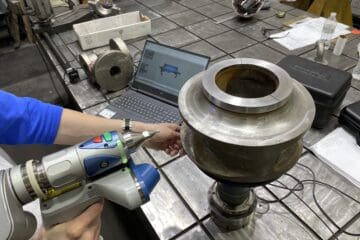
Using equipment such as a handheld X-ray fluorescence (XRF) analyzer, inspectors can identify and measure many metallic elements without significantly altering the component.
This is particularly valuable when visually similar alloys have very different performance characteristics.
For example, stainless steels and nickel-based alloys may look nearly identical while offering substantially different corrosion resistance, temperature performance, or mechanical properties.
PMI provides an additional verification step, although it does not replace full chemical analysis when elements such as carbon must be measured.
Effort Foundry includes PMI among its documented inspection and testing capabilities.
Military and nuclear applications may require extensive documentation, material traceability, qualified welding procedures, nondestructive examinations, and compliance with specific manufacturing standards.
Why Testing Matters for Military and Nuclear Applications
Quality requirements become especially important when castings are intended for critical-service environments.
Effort Foundry reports more than 150 military, ASME, and NACE weld procedure certifications, supporting its experience with demanding casting requirements.
Its work serving the nuclear industry illustrates why technical capabilities and casting quality documentation must work together.
Similarly, the company’s pump casting expertise demonstrates the importance of controlling complex geometries, material properties, and inspection requirements in components where reliability and performance matter.
No inspection method can guarantee that a component will never fail. However, a properly planned combination of manufacturing controls, testing, documentation, and inspection significantly strengthens confidence that specified requirements have been met.
Choosing a Foundry Partner: Ask About Quality Early
When evaluating a foundry, buyers should ask more than whether the company can produce the required casting.
Can it verify alloy chemistry? Does it have qualified inspection personnel? Can it perform the required mechanical testing? Are appropriate NDT procedures available? Can it provide the documentation and traceability required by the application?
These questions are especially important for low-volume, specialty, and complex castings, where every component may represent a significant investment.
At Effort Foundry, the objective is not simply to produce a casting that looks correct. It is to manufacture a component supported by the technical expertise, casting process controls, and verification required for its intended application.
Have a Challenging Casting Project? Let’s Talk.
Whether you’re sourcing a complex pump impeller, valve body, power-generation component, or casting for military or nuclear service, involving your foundry early can make a meaningful difference.
Send Effort Foundry your drawings, alloy specifications, anticipated quantities, and testing requirements. Our sales and technical teams can review your project, discuss applicable quality standards, and determine whether our capabilities are the right fit.
Because confidence in a casting should begin long before it enters service.
Effort Foundry — People. Capabilities. Solutions.